
I once spent forty minutes standing in front of a full wardrobe convinced I had nothing to wear.
Not because my wardrobe was actually empty. It was stuffed. Bags from Zara I had not returned, a blazer I bought for one wedding and never touched again, three versions of basically the same striped top, jeans in four different washes none of which felt quite right. Loads of stuff. Nothing useful.

My friend Nadia showed up that evening and I vented at her about it. She looked at the pile on my bed, then at me, and said something I still think about: “You have a lot of clothes and almost no wardrobe.”
She was right, and I did not fully understand what she meant until she explained it. A wardrobe is a collection of things that work together. What I had was a collection of individual purchases that made sense in the shop and less sense at home. Every piece was bought for how it looked on its own, not for how it would live in a real life with real clothes beside it.
Nadia has worked in buying for a fashion retailer for over a decade. She does not own a huge amount of clothing. What she owns looks expensive, fits well, and seems to go with everything else she has. I asked her once how she shops. She said she stopped buying trends a long time ago and started buying things that she could not imagine going out of style. Then she listed a few items.
That conversation changed how I think about clothes entirely. Here is what I learned.
Why Most Wardrobes Feel Useless Even When They Are Full
Before getting into the actual pieces, it is worth understanding why so many people end up in the same situation I was in.
Fast fashion made it extremely easy and cheap to buy things impulsively. A top that costs twelve pounds does not feel like a decision. It feels like nothing. So people buy it without thinking hard about whether it actually works with anything they own or whether they will still want it in eight months.
The result is wardrobes full of cheap singles. Things that seemed cute in isolation and now just take up space. Meanwhile the few things that actually get worn end up looking tired because they carry the entire workload.
The pieces on this list are not magic. They are just things that have been in fashion for decades and show no signs of leaving, things that work with other things, and things that reward buying them properly the first time rather than cheap and often.
The point is not to own less. The point is to own things that earn their place.
A White Shirt That Actually Fits Properly
Every person I know who dresses well owns at least one really good white shirt. Not a going-out shirt, not a formal shirt, just a plain white woven shirt that fits properly and feels like something.
The white shirt has been a wardrobe staple for so long that listing the decades would take a while. The reason it stays is that it is genuinely neutral in a way almost nothing else is. It does not compete with whatever you wear it with. It works under a jumper, over jeans, tucked into a skirt, layered under a suit. It is the only piece of clothing that does that without looking like it is trying.
The mistake people make is buying a white shirt that is slightly transparent, slightly off-white, or slightly too big in the shoulders. All three of those things make it look like a shirt you grabbed in a rush rather than something you chose. The collar matters too. A collar that collapses or curls ruins the whole thing.
What you want is a shirt with a bit of weight to the fabric, a proper structured collar, and a fit that skims your body without pulling anywhere. Uniqlo’s Oxford shirts are genuinely good for the price. Everlane and M&S both do reliable versions. If you find one that fits perfectly in the body but is slightly long in the sleeves, take it to a tailor. Sleeve shortening is cheap and it makes an enormous difference.
One good white shirt worn twice a week for two years beats five cheap ones every time.
Dark Jeans That Are Not Trying to Be Anything Except Jeans
Denim goes through phases. Everyone knows this. In the space of my adult life alone, jeans have been boot-cut, then skinny, then boyfriend, then straight, then wide, then crop, then everything at once.

Through every single one of those cycles, a dark wash, straight or slim-straight leg jean has always looked right. Always. It is one of the only things in fashion I would say that about with genuine confidence.
The reason dark jeans work so consistently is that the colour reads almost as a neutral. You can wear them with a blazer to a dinner and look appropriate. You can wear them with a plain white tee and trainers on a Saturday and look like you made an effort. They occupy this middle ground between smart and casual that almost nothing else manages.
The fit is where most people go wrong. Dark jeans that bunch at the ankle look sloppy no matter how well everything else is put together. Jeans that are too loose in the seat age the whole outfit. The rise matters, too. A mid-rise or high-rise tends to be more flattering and more versatile than a low-rise.
Levi’s make reliable dark jeans at a reasonable price. Madewell’s straight jean gets mentioned constantly by people who know about this stuff. AGOLDE if you want to spend more. If the length is not right, get them hemmed. Seriously. A tailor charges almost nothing to hem jeans and the difference is not subtle.
One Blazer in a Neutral Colour
Nadia told me once that a well-fitted blazer is the closest thing fashion has to a cheat code. I thought she was exaggerating. She was not.
A blazer does something that almost nothing else does: it makes whatever is underneath it look like an outfit. Jeans and a tee look like jeans and a tee. Add a blazer and suddenly it looks intentional. The same logic applies to a dress, to wide-leg trousers, to almost anything.
The colour that works hardest is navy. Not because it is exciting but because it goes with black, white, grey, camel, cream, denim, olive, pretty much everything. Charcoal grey does the same job. These are not interesting colours. That is the point.
Fit is non-negotiable here. The shoulder seam has to sit at the actual edge of your shoulder. Not a centimetre over it. A blazer with too-wide shoulders looks like a costume. If the body fits well but the sleeves are too long, a tailor can shorten them and it will look like it was made for you.
Fabric matters in blazers more than almost any other garment. A polyester blazer loses its shape quickly and you can often tell from across the room. A wool or wool-blend blazer drapes properly and holds up for years. It costs more upfront and far less in the long run.
For men, a single-breasted two-button navy blazer covers almost every situation between a job interview and a weekend lunch. For women, an oversized or longline blazer in the same colour does the same thing with more styling options. Both of those descriptions have been accurate for roughly forty years.
A Good Knit in a Neutral Shade
There is a version of this sweater in fashion photographs from the 1950s. There is a version of it in every autumn collection that came out in the last ten years. It is a simple, fine-gauge knit, crew or V-neck, in cream, off-white, oatmeal, or soft grey. Not chunky. Not thin. Just a proper knit that sits on the body cleanly.
This sweater works because it adds warmth and texture without adding visual complication. It goes under a coat. It layers over a collared shirt. It pairs with jeans and with trousers and with skirts. It is one of those pieces where you keep reaching for it because it never seems like the wrong choice.
The fabric determines everything. A cashmere or merino knit looks and feels different from a synthetic blend in a way that is immediately obvious. It also lasts dramatically longer. Quince does cashmere at a lower price point than most people expect. Uniqlo’s merino range is excellent value. John Lewis and M&S both do reliable wool-blend options.
The care is simple. Turn it inside out before washing, cold water, lay flat to dry. Do not put it in a dryer. Do not hang it wet. Those two rules and a decent-quality knit will last you ten years without a problem.
A Leather Belt With a Simple Buckle
This is the item people buy badly most often and notice the least.
A belt with a plastic buckle that starts to peel, a belt that is slightly too shiny, a belt with a logo on the buckle that screams its brand, these things are visible in a way people do not realise. Not consciously visible. But the whole outfit feels slightly off and you cannot work out why.

A leather belt in tan or black, plain buckle in silver or gold, no branding, holds an outfit together in a way that is invisible when it is right. And that is exactly what you want.
Buy a leather one. A real one, or at minimum a good quality leather-look one. It will cost more than the plastic version and it will last five times as long. This is one of those small items where quality pays back immediately.
The Trench Coat That Works for Everything
The trench coat has been in continuous mainstream use since the 1940s. That is not nothing.
It works because the silhouette does something no other coat manages to do quite as well: it is formal enough to wear over a suit and casual enough to throw over jeans without looking overdressed. It is also practical in the kind of weather that is not quite cold enough for a heavy coat but too unpredictable to leave the house in just a jacket.
The version that has lasted longest is the mid-length double-breasted style in camel or khaki. That description fits coats from the 1950s and it fits coats on the high street right now. Burberry invented the modern version of it and their pricing reflects that history. But Zara, M&S, Banana Republic and ASOS have all produced very solid versions over the years that hold up well.
Second-hand is worth considering seriously here. A trench coat from a quality brand bought second-hand in good condition will outlast a cheap new one by years. Vestiaire Collective, Vinted, and Depop all regularly have them.
The fit needs proper attention. Shoulders must sit right. The belt should create a waist, not just hang open. Sleeve length matters. These are all things a tailor can adjust if you find a coat that is right everywhere except one or two details.
Clean White Trainers
I know trainers feel like a trend item but white leather trainers have been around since at least the 1980s and they have not left once in that time. The Stan Smith came out in 1971. The Air Force 1 in 1982. Both are still being sold today because they keep getting worn.
White trainers work because they are neutral the same way a white shirt is neutral. They do not fight with what you are wearing. They go with dresses, with jeans, with wide-leg trousers, with almost anything that is not a black-tie event and sometimes even then.
The only thing that makes them stop working is letting them get grey and scuffed. Clean them. A damp cloth and a small amount of mild soap every couple of weeks is all it takes. Ten minutes. Do it while watching something.
Stan Smiths and Air Force 1s are the most proven options. Common Projects if you want something cleaner and more minimal and are comfortable spending more. All three have been made without significant design changes for decades.
The Mistakes Worth Knowing Before You Go Shopping
The biggest one is buying these pieces cheaply and being surprised when they do not last or look as good as you hoped. A classic silhouette in poor fabric still looks cheap. That is not a paradox. That is just how fabric works.
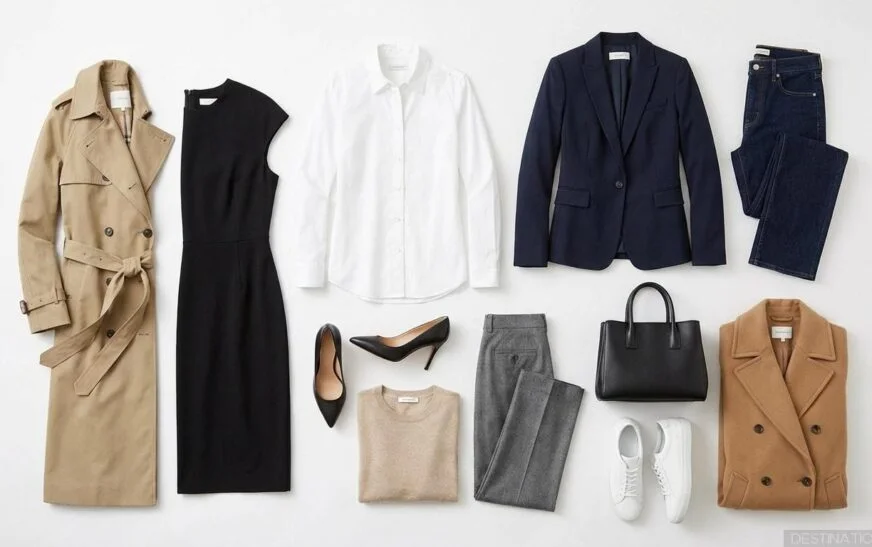
The second mistake is buying the shape but in a colour that does not work with anything you already own. Navy blazer, white shirt, dark jeans, camel trench, cream knit, white trainers, these work together because the colours are compatible. Buying a lime green version of a classic shape because it was on sale defeats the whole exercise.
The third mistake is buying things that are almost the right fit and hoping. Almost never becomes fully. Get things that fit or get things altered. A twenty-pound alteration on a sixty-pound jacket is not extravagant. It is the reason the jacket looks like something.
The fourth mistake is trying to replace a whole wardrobe at once. Nobody needs to do that and nobody can do it well all at once. Buy one thing. Wear it. See what it makes you reach for. Then fill that gap next.
Where to Actually Start
Go to your wardrobe right now and pull out everything you have worn in the last three weeks. That pile is your actual wardrobe. Everything still hanging up untouched is an aspiration, not a reality.
Look at what you pulled out and ask what is missing from it. What do you keep wishing you had when you are getting dressed? That is your first purchase.
Before you buy anything, ask yourself whether you can think of three things you already own that the new piece would work with. If the answer is no, it is probably not a wardrobe staple. It is probably something that caught your eye and will catch dust in six months.
Nadia said something else that evening that stuck with me. She said the wardrobe she has now took about three years to build properly. One good piece at a time, filling gaps as she found them, not buying anything that did not have a clear reason to be there.
Three years sounds long. But she has been wearing the same core pieces for the last decade and they still look good.
My Zara bags from 2019 do not exist anymore.
I think about that a lot.
Morning Habits of Highly Successful People That Actually Work
My brother-in-law Tariq used to call me at 9 AM and I would still be in bed. Not sleeping exactly, just lying there half-conscious with my phone on my chest, scrolling through stuff I would not remember an hour later. He would ask what I was doing and I would say “just waking up” like that explained why I sounded like I had been dragged out of a river.

He runs a small import business and at the time he was calling me from his office, having already been awake for three hours.
I thought he was just one of those people. You know the type. Born wired differently. Naturally a morning person. I told myself I was a night owl and left it at that.
Then I got a project deadline that forced me to start working earlier for two weeks straight. Not because I wanted to, because I had no choice. And something strange happened. By the end of those two weeks I felt more on top of things than I had in months. I was not doing anything dramatically different. The hours were just different.
That was four years ago. I still do not wake up at 4 AM and I do not own a gratitude journal. But my mornings are completely different from what they were, and the difference it has made to how productive and calm I feel on most days is real enough that I want to share what I actually learned, not what the Instagram version of a morning routine looks like.
The Thing Nobody Tells You About Successful People and Mornings
Here is what I noticed when I started reading about how high-performing people structure their days. The specifics vary wildly. Some wake at 4:30. Some at 6:30. Some journal, some do not. Some run ten kilometres, some just stretch for five minutes.
The one thing they share is not a specific habit. It is that the first hour of their day belongs to them.
Before anyone can send them a problem to solve, before the news cycle starts pulling at their attention, before their phone fills up with messages that need replies, they have already done something that mattered to them. Work, movement, quiet, whatever it is. That hour is theirs before it belongs to the world.
That reframe changed how I thought about mornings entirely. It stopped being about waking up early for the sake of it and started being about protecting some time before everything gets complicated.
What Happens to Your Brain in the Morning That You Are Probably Wasting
There is a window right after you wake up, maybe 45 minutes to an hour, where your brain is in a genuinely different state than it will be for the rest of the day.
It is not fully switched on yet. It is loose, wandering, making odd connections. This is actually the state where creative thinking and problem solving happen most naturally. Writers know this. Musicians know this. A lot of people have their best ideas in the shower or while making coffee because that is when the brain is still in that half-awake mode.
The moment you open your phone and start reading messages or scrolling through social media, that window closes. Your brain snaps into reactive mode. Now it is processing other people’s words and problems and opinions rather than doing its own quiet work.
Most people spend that window reading things they will forget by lunchtime. Successful people, maybe without even knowing why, tend to protect it. They do something that belongs to them before they let the outside world in.
Practically speaking, the simplest thing you can do is charge your phone outside your bedroom. That one change, which costs nothing, eliminates the automatic reach for the phone before you are even sitting up. It sounds small. It is not small.
Waking Up at the Same Time Every Day Is More Important Than Waking Up Early
I spent a while trying to force myself to wake up at 5:30 because I had read that enough times to feel like I was supposed to. It did not go well. I was exhausted by Thursday, useless by the weekend, and eventually gave up and slept until 8:30 on Saturday to catch up.

The catch-up sleep made everything worse the following week because my body had reset its internal clock again.
What actually fixed my mornings was picking a time that was realistic, not impressive, and sticking to it every day including weekends. For me that ended up being 6:45. Not glamorous. But consistent.
Your body runs on a biological clock that regulates when you feel alert and when you feel sleepy. When you wake at wildly different times depending on the day, that clock never settles. You feel groggy more often because your body is always recalibrating. When you wake at the same time consistently, your body starts waking you up slightly before the alarm. The cortisol your brain releases naturally in the morning, which is what makes you feel awake and alert, starts timing itself to your schedule.
If you want to wake earlier than you currently do, move in fifteen minute increments over a few weeks. It is tedious but it is the only approach that actually sticks without making you miserable.
Moving Your Body in the Morning Does Not Mean Training for a Marathon
When people hear “successful people exercise in the morning” they picture a CEO doing a 90-minute CrossFit session at 5 AM before a cold shower and a green smoothie.
That is not what is actually happening for most people who have figured out morning movement.
My sister-in-law, who is a school principal and one of the most organised people I know, does fifteen minutes of yoga in her living room before her kids wake up. That is it. No gym. No trainer. Just fifteen minutes on a mat with a YouTube video she likes.
She told me she started doing it because she was constantly reactive at work, always in firefighting mode, and someone suggested that even a short morning movement practice can help regulate your nervous system before the day starts. She tried it. It worked. She has done it almost every weekday for two years.
The research backs this up. Even light movement in the morning, a short walk, some stretching, bodyweight exercises, raises your heart rate, gets blood moving to your brain, and releases endorphins that affect your mood for hours. You do not need intensity. You need consistency.
The thing that makes morning movement sustainable is not finding the most effective workout. It is finding something you do not dread. A walk around your neighbourhood with no headphones. Ten minutes of stretching while your coffee brews. Whatever the bar is low enough that you will actually clear it.
What You Eat in the First Hour Sets the Tone for the Rest of the Day
I used to skip breakfast or grab something from a bakery near my office. A croissant, a pastry, sometimes nothing. By 10:30 I was either crashing or so hungry I could not focus.

The issue with sugary or refined-carb heavy breakfasts is that they create a blood sugar spike that feels like energy for about an hour and then drops you. You feel worse than if you had eaten nothing. And the hunger that follows is aggressive.
Switching to something with protein in it, eggs in some form, Greek yoghurt with nuts, a smoothie with protein powder and peanut butter, made a noticeable difference in how I felt between breakfast and lunch. Not dramatic. Just steadier. Less of that mid-morning fog.
You do not need to track macros or use an app, though Cronometer and MyFitnessPal exist if you want to understand your eating patterns better. You just need to notice how you feel two hours after different kinds of breakfast. Most people figure out pretty quickly that protein in the morning holds better than sugar.
If you do intermittent fasting and feel good skipping breakfast, that is genuinely fine. The point is not that everyone must eat at 7 AM. The point is that whatever you do eat, make it something that works for you rather than something that is just convenient.
The Habit of Deciding the Night Before What the Morning Is For
This one changed my mornings more than almost anything else.
When I had no plan for the morning, I filled it with easy things. Email, Twitter, reading things I had bookmarked, making a second coffee. Things that felt productive but were not getting anything real done.
When I decided the night before what I was going to work on first thing, I sat down and did it. Not always immediately, not always perfectly, but I did it. The decision had already been made so there was nothing to debate.
It does not need to be elaborate. Just write down the one thing you most need to do tomorrow. One thing. Put it somewhere visible, a sticky note on your laptop, a note on your phone, whatever. When you wake up, your first work task is already chosen.
Cal Newport calls the deep, focused version of this kind of work your most cognitively demanding task. His argument, which I think holds up, is that you have a limited window of real mental sharpness each day and most people accidentally spend it on low-effort tasks. Protecting that window for the thing that actually matters is not a personality type. It is a decision.
Something in the Morning That Is Just for You
Here is the part of morning routines that almost no productivity writer talks about because it sounds too soft to include in a list of habits.
Every person I know who has a morning routine they have kept for longer than six months has something in it that they genuinely look forward to. Something that is not productive in any measurable sense. Just something they like.
One person I know spends ten minutes making pour-over coffee properly because he finds the process calming. A friend reads two or three pages of whatever novel she is in the middle of while eating breakfast, not to improve herself, just because she likes reading and the morning is the only time she gets to do it without interruption. My wife does a crossword puzzle on her phone before she gets out of bed. Not Instagram, not email. A crossword.
These things do not make you more successful in any direct way. But they make the morning feel like something you chose rather than something that happened to you. And that feeling carries into the day.
If your morning is entirely obligation, something you have to do before something else you have to do, you will find reasons to skip it. If there is something in it that you want to do, you will get up for it.
The Mistakes That Kill Morning Routines Before They Start
The most common mistake is trying to build a full routine in one go. Someone gets inspired, writes a plan that involves waking at 5, meditating, exercising, journaling, and reading by 7, tries it on Monday, cannot sustain it by Wednesday, and concludes that they are just not a morning person.
Routines are built in pieces. One habit, done consistently until it becomes automatic, and then one more. If you try to install six habits simultaneously, they all compete for willpower you do not have yet.
The second mistake is copying someone else’s routine without asking whether it fits your life. A routine that works for a single person in their thirties with no kids looks nothing like what works for someone with a toddler and an unpredictable schedule. The structure is the same, protect some time for yourself before the day starts, but the contents have to be yours.
The third mistake is treating one bad morning as evidence that it does not work. You sleep through the alarm. You get sick. Your kid has a nightmare at 3 AM and you are useless by 6. These things happen. They are not failures. The only thing that matters is coming back the next morning without making it into a bigger story than it is.
A Realistic Way to Start This Week
Do not overhaul everything. Pick one thing from this list that feels genuinely possible.
If your mornings are chaotic because you are always rushing, set your alarm fifteen minutes earlier for two weeks and use that time to sit quietly before checking your phone. Just that.
If you tend to feel foggy and unproductive all morning, try eating something with protein for a week and see if it changes how you feel by 10 AM.
If you have no plan for what to work on when you sit down, spend two minutes the night before writing down your one most important task for the next morning.
Pick one. Do it for two weeks. Notice whether anything changes. That noticing is the thing that actually motivates you to keep going, far more than reading articles about what time famous people wake up.
Tariq, my brother-in-law, asked me recently how my mornings had changed since those early phone calls. I told him the truth. I am not waking up at 5 AM and I am not doing anything Instagram-worthy before 7. But I get more done before noon than I used to get done in a full day.
He said that sounds about right.
He was correct.